In 1990 global finance was already a powerful engine of growth and allocation: banks underwrote trade and credit, national exchanges listed the bulk of public companies, and cross‑border flows were meaningful but comparatively narrow. Thirty‑six years on — in 2026 — the system that performs those same functions is vastly larger, far more fragmented and woven together by instruments and plumbing that would have been alien to the market participants of 1990. The differences are not merely quantitative. They change how risk forms, how quickly it spreads, which institutions are critical and what policy makers can plausibly do when markets seize up.
The most visible change is scale. World equity markets that were a large multiple of annual production in 1990 have ballooned in nominal terms and, in many economies, have come to exceed GDP by wide margins. Where global market capitalisation in 1990 was measured in the low tens of trillions of dollars, by the mid‑2020s public and private claims together represent many multiples of annual world output. That expansion reflects decades of financial deepening: broader retail and institutional participation, cross‑border listings, and an explosion of securitised and private‑market instruments.
Complementing equity growth, the asset‑management industry transformed from a relatively modest custodial sector into a dominant allocator of capital. Global assets under management — pensions, mutual funds, exchange‑traded funds, sovereign wealth and private‑markets vehicles — rose from a fraction of their present size to well over a hundred trillion dollars by the early 2020s. The result is a new centre of financial gravity. Whereas the 1990s saw credit creation and intermediation concentrated in banks, the 2020s feature a roughly equal partnership between banks and an enormous non‑bank financial intermediation complex whose balance sheets and liquidity behaviour matter hugely for markets and economies.
Beyond sheer size, the composition of claims changed profoundly. Derivatives existed in 1990, largely exchange‑traded futures and options and a still‑growing over‑the‑counter swaps market. By 2026 derivatives markets — interest‑rate swaps, FX swaps, credit derivatives and a profusion of structured products — are orders of magnitude larger in notional terms. The notional values outstanding in OTC derivatives rose from relatively modest levels in 1990 to figures in the many hundreds of trillions by the 2020s. Notional numbers overstate economic exposure, but so do they highlight how deeply hedging, leverage and counterparty chains have been embedded in everyday finance. Netting, collateral and central clearing reduce some bilateral grossness; but these technical fixes also concentrate counterparty importance into clearing houses and custodians, making those nodes systemic in a way that had no analogue three decades earlier.
Equally consequential is the globalisation of debt and funding markets. International bond markets, dominated increasingly by dollar and euro issuance, are both deeper and more accessible to non‑bank investors than in 1990. Cross‑border bank claims grew markedly over the intervening years, yet even that growth is dwarfed by the expansion of non‑bank instruments — repo, securities financing transactions, money‑market funds and other short‑dated wholesale funding channels — that now mediate liquidity across borders. Shadow banking, a term scarcely used in 1990, became by the 2010s a shorthand for these parallel funding architectures, with asset pools measured in the tens of trillions and intricate links to banks and capital markets.
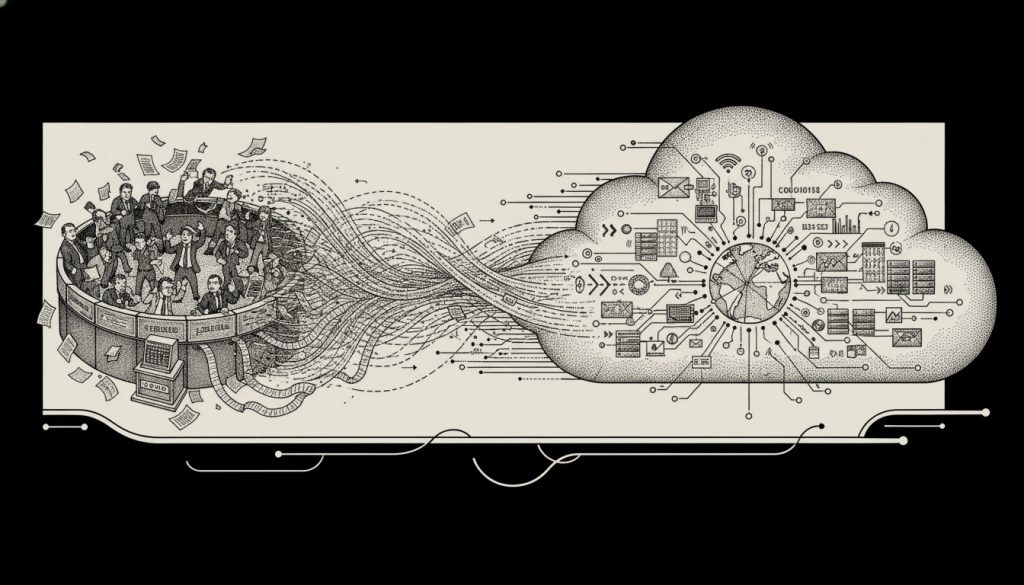
Perhaps the clearest stylistic difference between 1990 and 2026 is speed. Marketmaking and price discovery that once depended on pit trading, telephones and human intermediaries have migrated to electronic limit‑order books, centralised matchers, dark pools and inter‑dealer platforms. Foreign‑exchange trading that in 1990 registered daily volumes in the low hundreds of billions now routinely trades several trillion dollars per day; the BIS Triennial Surveys record daily FX turnover in the multi‑trillion range in the 2020s. In equities and FX alike, algorithmic strategies and high‑frequency trading account for the majority of intra‑day flow in major venues. That shift has improved liquidity in normal conditions, narrowed spreads and allowed for near‑continuous price discovery across time zones. It has, however, created new fragilities: latency arbitrage, cascading automated strategies, and flash events where a local liquidity shortage can metastasise into system‑wide repricing in minutes.
Interconnectedness in 1990 was substantial but topologically simpler: bilateral cross‑border bank claims, portfolio holdings and trade credit created a network whose principal nodes were national banking systems and a handful of global dealers. By 2026 the network has many more kinds of nodes and many more edges. Mutual funds, ETFs, pension funds, private‑equity firms, central counterparties (CCPs), prime brokers, central banks and fintech payment rails all form interlocking relationships. OTC derivatives create contractual links that tie institutions together even when direct equity cross‑holdings are modest; repo and securities financing transactions create chains of collateral dependence; and delegated asset management produces common ownership of the same traded instruments by multiple large managers.
The practical upshot is a denser graph: shocks can now traverse more pathways. A funding squeeze in one corner of the repo or MMF market can force liquidations by large asset managers, which compress prices across assets, triggering margin calls on derivatives, tightening funding for banks and placing strains on CCPs. In 1990 comparable stresses existed, but the web had fewer alternative conduits and fewer concentrated intermediaries whose simultaneous distress could amplify shocks across multiple asset classes.
Concentration has risen in subtle but important ways. The 1990s financial system had large banks and dealers; the 2020s financial landscape adds a handful of asset managers and market‑infrastructure providers whose scale places them at the heart of many markets. A failure or abrupt risk‑management shift at a top global dealer, a major asset manager or a critical CCP can have outsized market consequences. Central clearing reduced bilateral counterparty exposure, but it also made CCPs focal points whose operational resilience is critical for market functioning. This concentration contrasts with the 1990s, when the locus of systemic importance was more diffusely spread across banking systems and fewer infrastructure monopolies existed.
Since the global financial crisis, regulators have strengthened capital, liquidity and resolution regimes, expanded central clearing of standardised derivatives and developed macroprudential tools to contain system‑wide risk. Central banks have also forged swap lines and liquidity backstops of a scale unimaginable in 1990. These adaptations have changed the landscape: some risks that once propagated via simple bank runs are now partly contained by buffers and centralised utilities. Yet the same changes introduce new dilemmas. CCPs require robust margining and default management, but they also concentrate the need for credible public backstops. Cross‑border coordination is better than in 1990 but remains imperfect; regulatory fragmentation and geopolitical frictions complicate the governance of a truly global network.
Paradoxically, while data collection about markets is far richer in 2026, opacity in important corners has increased. Trade reporting, supervisory data and public disclosures now allow granular views of many markets. Still, private‑market exposures, complex OTC nets, rehypothecated collateral chains and rapid intraday funding dynamics can hide critical build‑ups until they unwind. Netting and central clearing made some bilateral exposures easier to assess, but the proliferation of intermediaries and new instruments — including tokenised assets and algorithmically traded instruments — introduced novel blind spots. The measurement problem itself has become a systemic feature: policy makers can see more but may still learn about dangerous concentrations only as they unwind.
The 2026 system includes elements absent in 1990 that reshape risk: digital assets, stablecoins and tokenised securities; instant payment rails and alternative settlement networks; and widespread use of machine learning in pricing, execution and risk modelling. These features create efficiencies and new distribution channels for capital, but they also add technological and model risks. AI‑driven strategies can create feedback loops; private rails and crypto markets can amplify cross‑border spillovers when correlated liquidity is sought; cyber vulnerabilities and software failures are now plausible causes of market stress in a way that would have been inconceivable in 1990.
The increased size, complexity and interconnectedness of global markets since 1990 bring both benefits and dangers. Deeper, more liquid and more widely shared capital markets allow better risk allocation, permit macroeconomic smoothing and facilitate financing at lower costs. Global investors can diversify across hundreds of markets and instruments; multinational corporations can hedge exposures with sophisticated derivatives; and central banks can coordinate to backstop liquidity in crisis.
Yet those very features also create channels for faster and broader contagion. Larger balance sheets and more complex instruments expand the set of plausible failure modes. Concentration in critical intermediaries increases single‑point systemic risk. Automation compresses reaction times. And the global reach of funding and derivatives means a shock in one country can transmit almost instantly to many others through non‑bank conduits that did not exist in 1990.
Viewed from 1990, the financial system of 2026 is unrecognisable in its scale, its speed and the intricacy of its linkages. The old architecture — banks, local exchanges, telephone trading and bilateral credit lines — has given way to a multi‑layered global market whose hubs include not only banks but asset managers, CCPs and digital rails. That evolution has improved capital allocation and broadened participation, but it has also multiplied pathways for contagion and concentrated risks in a few critical nodes.