China’s recent high-profile removals of senior People’s Liberation Army officers — culminating in the January 2026 public investigation of Gen. Zhang Youxia and probes of other top commanders — read as an instrument of political consolidation that also exposes tensions between party control, military professionalization and operational readiness. The campaign, unusually swift and deep, has hit figures across services and procurement agencies, removed longtime allies, and narrowed effective decision-making within the Central Military Commission to Xi Jinping and a shrinking circle. To understand its significance we need to place these developments against the PLA’s institutional role in Chinese society, the logic and mechanics of Xi’s campaign, and the likely effects on military effectiveness and regional stability.
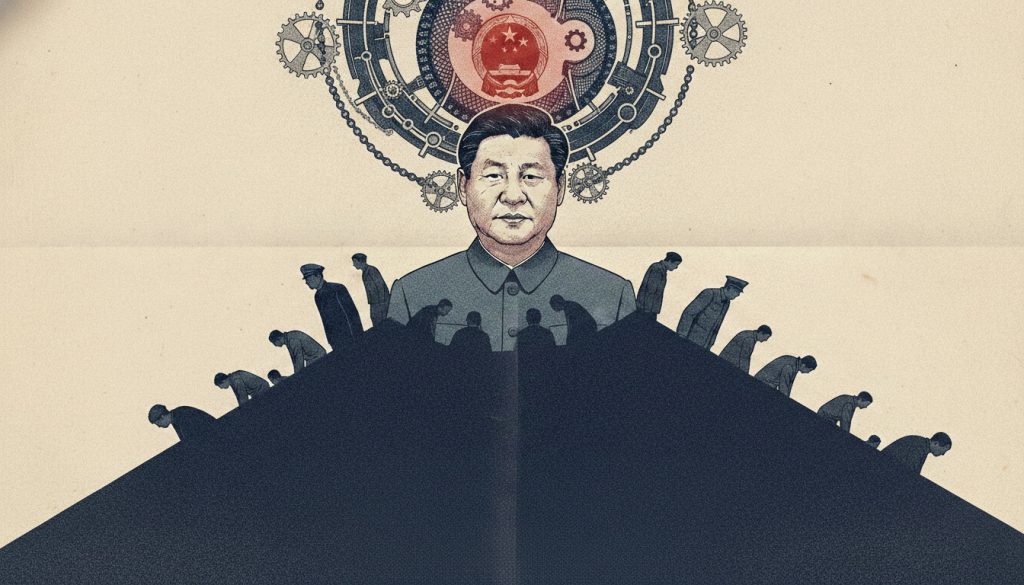
The PLA exists as the Chinese Communist Party’s coercive arm: constitutionally and politically subordinate to the party rather than the state. It performs a dual function — defending the country while acting as an engine of elite status, patronage, industrial integration and local employment. Senior officers traditionally combine military command with party roles and ties into civilian power networks. Since the 1990s the CCP has pushed for modernization — joint operations, technology and expeditionary capacity — while tightening political control through party committees, the Central Military Commission and political commissars. That uneasy balance between professional competence and political loyalty is the context in which Xi’s recent purges must be read.
Xi’s motives are multiple and overlapping. The likely primary motivation is centralizing authority. The purge removes potential independent power centers and replaces them with officers who are personally loyal or institutionally tethered to Xi’s vision. Anti‑corruption charges provide an administrable pretext — investigations cite “serious violations of party discipline and state law” — and corruption in procurement and patronage networks supplies ample grounds for disciplined removal. The campaign also functions as risk management ahead of potential use. If Beijing contemplates higher‑stakes coercion, Xi appears intent on ensuring a compact, controllable officer corps that will obey without hesitation. Institutional instruments — party disciplinary bodies, military prosecutors, state media messaging and rapid public announcements — are deployed to decapitate networks and deter dissent.
The immediate implications for the PLA are stark. Rapid removal of senior, experienced officers — especially those with combat or procurement expertise — disrupts continuity in planning, logistics and long‑lead modernization projects. Replacing them with less‑experienced but politically reliable cadres risks shortfalls in operational competence. Procurement and technology programs that touch exposed defense‑industrial channels may slow as investigations and personnel churn delay projects and unsettle suppliers. Morale and initiative suffer too, fear of being purged produces risk‑averse behaviour among mid‑level commanders, reducing decentralized decision‑making and adaptive battlefield leadership—costly deficiencies in modern, tempo‑driven warfare. The campaign may harden formal loyalty but hollows organizational trust; an officer corps that operates primarily to avoid suspicion becomes less candid with superiors and less willing to surface hard truths.
Regionally and geopolitically the purge raises mixed signals. Domestically it broadcasts that Xi controls the military, deterring internal challenges. Externally it increases uncertainty about China’s willingness and capacity to escalate in crises. A tightly controlled military could be used deliberately and swiftly, yet may also be less competent in complex campaigns. Around Taiwan the risk calculus is ambiguous. Western analysts point to two competing dangers. A politicized officer corps could be ordered into a risky operation for political ends; conversely, degraded readiness could make Beijing less willing to attempt a risky invasion, increasing the chance of coercive pressure short of war. Both outcomes complicate deterrence planning in Washington, Taipei, Tokyo and Seoul. Allegations of leaks to foreign powers — difficult to independently corroborate — will prompt harder counterintelligence measures that could further impede cooperation with civilian scientific and industrial partners.
Historical precedents supply partial analogues. Mao‑era political purges decapitated expertise at great cost, while Deng’s reforms aimed at professional rebuilding. Xi’s campaign fuses both motifs — pursuing modernization while ruthlessly removing perceived political threats — and in that mixture lies the central uncertainty. Unlike earlier eras, China now possesses a larger, more sophisticated industrial base and a deeply embedded party apparatus, making outcomes less predictable than a simple replay of past mistakes.