When the European Central Bank unveiled a permanent, globally available euro repo backstop in February 2026, it did more than tweak crisis plumbing: it signalled an institutional ambition to tilt the architecture of global finance. By converting temporary emergency lines into a standing facility — offering up to €50 billion in euro liquidity to eligible foreign central banks against high‑quality euro collateral — the Eurosystem aimed to remove a persistent obstacle to wider international use of the euro. The step is at once technical and tectonic: technical because it changes how euro liquidity is supplied under stress; tectonic because it seeks to reshape incentives that determine which currencies central banks, banks and corporates prefer to hold and use across borders.
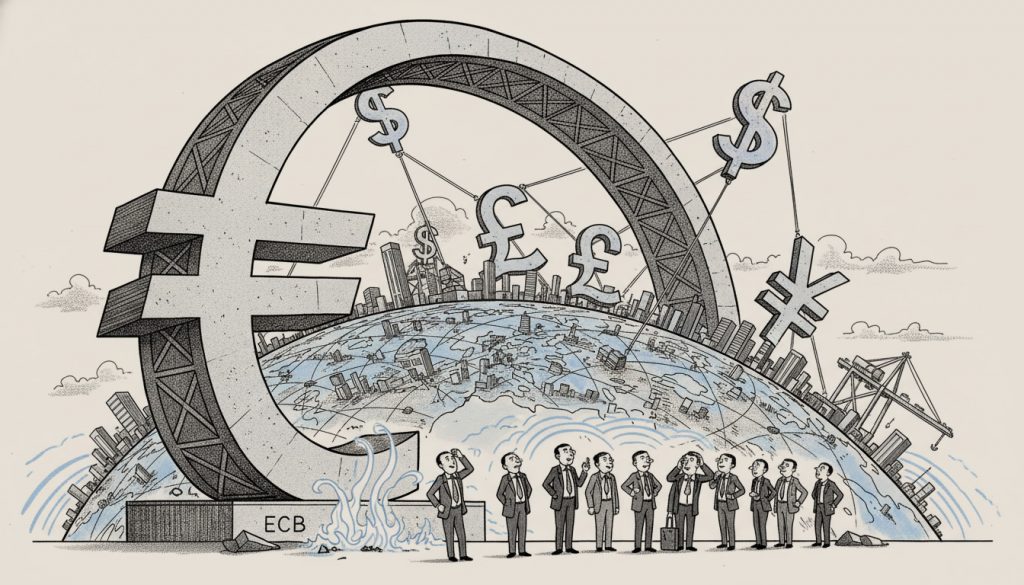
To appreciate the move fully requires situating it within several overlapping histories: the euro’s long, uneven quest for international status; the evolution of central‑bank crisis tools since 2008; the geopolitics of currency and sanctions; and recent market episodes that exposed vulnerabilities in cross‑border euro markets.
From its creation in 1999 the euro was designed to be more than an internal unit of account for European integration: its architects envisaged a currency that could rival the U.S. dollar as a reserve, invoicing and settlement medium. Early momentum suggested a plausible trajectory. The euro quickly became the second most important reserve currency and a major invoicing currency for trade within Europe. But over two decades the dollar’s incumbency proved resilient. Network effects — whereby widespread use begets more use — favoured the dollar. Deep, liquid U.S. Treasuries, extensive dollar funding markets, and the dollar’s centrality to commodities and cross‑border contracts created a virtuous cycle hard for any rival to break.
Structural frictions have long constrained the euro’s broader adoption. Chief among these has been liquidity risk outside the euro area: when global tensions spike, non‑euro holders have worried that they cannot readily access euros without selling assets at fire‑sale prices or enduring steep funding costs. That fragility is not merely theoretical. Episodes such as the global financial crisis of 2007–09 and the euro‑area sovereign debt crisis of 2010–12 exposed how quickly cross‑border funding strains can blow back on markets. In those moments, central banks — including the Federal Reserve with its swap lines — stepped in to supply dollars, underscoring the advantage of being the issuer of a currency that others depend on.
The global financial crisis transformed central banking. Emergency liquidity facilities, unconventional asset purchases and swap lines became part of the central‑bank toolkit. Swap lines in particular — reciprocal arrangements to exchange currency between central banks — were a blunt but effective way to relieve dollar shortages. The Fed’s swap network during 2008 and again in 2020 was decisive in calming markets. Europe’s experience was more mixed. While the Eurosystem used targeted measures to stabilise domestic markets, the absence of a permanent, visible euro‑offering mechanism to the rest of the world remained salient.
During the Covid shock of 2020 the Fed again extended dollar liquidity globally, and the ECB temporarily broadened euro repo access to select central banks. Those ad hoc arrangements demonstrated both demand for euro liquidity and the political limits of temporary, episodic measures. The 2026 shift to a permanent, global Eurep thus builds on a decade and a half of institutional learning: permanent facilities reduce the need for last‑minute political packaging, create clearer expectations, and improve the signalling value of backstops.
The new facility operates through repurchase agreements: eligible central banks can obtain euros by posting high‑quality euro‑denominated collateral and drawing up to an established limit (the announced aggregate cap is €50 billion). National central banks within the Eurosystem conduct the transactions under guidance and risk frameworks set by the ECB. Importantly, the facility is open to central banks outside the euro area, subject to reputational checks and sanctions screening. The ECB will publish aggregated usage data without naming borrowers.
That structure matters. By offering a standing, rule‑based source of euro liquidity, the facility reduces tail risk for official and private holders of euro assets. If foreign central banks and official creditors believe they can access euros in stress, they are more likely to increase euro holdings or invoice trade in euros. For private markets, the assurance can narrow funding premia, deepen euro money markets and lower the liquidity premium investors require to hold euro instruments. Over time, these changes increase the attractiveness of euro assets relative to dollar assets—particularly for economies seeking diversification.
Currency status is not a purely economic phenomenon; it is entangled with geopolitics. The dollar’s dominance is reinforced by U.S. regulatory reach and the fact that many global contracts route through U.S. clearing and payment systems. In recent years, the geopolitical use of economic levers — sanctions, de‑risking and regulatory pressure — has underscored the strategic value of currency independence. European policymakers, mindful of risks from overreliance on a single currency or foreign‑dominated payment rails, have sought tools that increase strategic autonomy.
The ECB’s facility is carefully calibrated to navigate this terrain. By subjecting applicants to reputational and sanctions checks, the ECB signals that access is not unconditional; the Eurosystem will not become a conduit for entities under international sanctions. Yet that same selectivity has geopolitical implications. If the ECB excludes certain jurisdictions, those countries may accelerate pivoting toward alternative currencies or bilateral arrangements. Conversely, if the Eurep proves a reliable source of liquidity for allies and neutral partners, it becomes part of a broader European strategy to offer an alternative financing ecosystem to the dollar‑dominated one.
The ambition of a global backstop does not make it riskless. Moral hazard looms: with a visible lender of last resort, counterparties may take on higher liquidity risk, expecting ECB assistance. The Eurosystem attempts to mitigate this through strict collateral standards, counterparty assessments and the finite €50 billion cap. But these measures are imperfect shields. Repeated or large drawdowns would test the political will across euro‑area national central banks, especially if usage emerged in geopolitically sensitive contexts or if the Eurosystem faced losses.
Another constraint is scale. The facility’s €50 billion cap is meaningful as insurance but small relative to the size of global FX reserves and offshore funding markets. It is a credibility‑enhancing instrument rather than a wholesale substitute for dollar liquidity provision. Moreover, deepening the euro’s international role requires complementary changes: deeper and more liquid euro corporate and sovereign bond markets, more euro‑denominated trade invoicing, harmonised legal and settlement infrastructures, and greater willingness among private investors and sovereigns to hold euro liabilities. The backstop reduces a key deterrent but does not by itself create the market depth and network effects that produce long‑lasting currency shifts.
History offers useful parallels. The Fed’s post‑2008 swap lines improved dollar liquidity access for foreign central banks and arguably helped cement dollar centrality. Similarly, the Bank of England and other central banks have used standing facilities to provide local currency liquidity. What distinguishes the ECB’s step is its outward ambition combined with a careful, rule‑based posture. The euro is not seeking to displace the dollar by force; the ECB is instead addressing a technical barrier — episodic liquidity scarcity — that has reduced the euro’s attractiveness. That technical fix, however, may have outsized strategic consequences over time.
It is also worth recalling the euro’s own internal trials. The sovereign debt crisis and subsequent policy responses — banking union proposals, fiscal debates, and support mechanisms — left a legacy of caution and institutional reform. The ECB’s new measure reflects that learning: the Eurosystem now acts with a clearer sense of its role in maintaining market functioning beyond narrow domestic stabilisation. Yet European efforts to internationalise the euro have always been contested domestically: policymakers must balance credibility and prudence with geopolitical aspirations. The backstop is a political compromise — visible, but capped and conditional.
The future impact of the global backstop depends on how markets and policymakers respond. Several plausible paths exist:
- Modest but meaningful uptake: A range of middle‑sized central banks use the facility as insurance, euro assets see small but persistent increases in demand, and euro money markets become somewhat deeper. The euro’s international share inches upward over years.
- Non‑linear acceleration: If several influential official holders — central banks, sovereign wealth funds, or major supranational institutions — decide to re‑allocate reserves meaningfully toward the euro, network effects could accelerate. Greater invoicing in euros by energy and commodity trades would reinforce this shift.
- Limited take‑up and political friction: If usage remains negligible — treated as a political signal rather than a market tool — or if geopolitical tensions make access politically fraught, the facility’s strategic impact could be muted. Adverse reactions from major partners, or repeated large drawdowns that politicise the facility, could constrain its future.
Several indicators will reveal whether the facility is transformative or symbolic. First, aggregate usage and the identity of borrowers (even if anonymous in public reports) will indicate whether central banks find it operationally useful. Second, changes in euro reserves, portfolio allocations by official institutions, and invoicing practices in trade statistics will show whether behaviour shifts. Third, market outcomes — narrower euro funding premia, deeper short‑term euro markets, and reduced volatility in stress episodes — would signal real plumbing improvements. Finally, diplomatic responses, especially in Washington and major emerging economies, will shape whether the facility becomes a focal point of strategic competition or a cooperative complement to global liquidity architecture.
The ECB’s decision to make a euro backstop global is a layered initiative: a technical enhancement of crisis‑management capacity, a credibility play to reassure holders of euro assets, and a geopolitical nudge to rebalance the currency landscape over the long run. It addresses a concrete market failure — intermittent euro liquidity shortages — that has restrained the currency’s wider use. History suggests that changing the global monetary order is slow and path‑dependent, anchored by network effects and deep financial markets. Yet incremental institutional reforms that alter incentives and reduce friction can compound into meaningful shifts over time. By bolstering the euro’s safety as a reserve and settlement currency, the ECB has added a potentially consequential element to Europe’s economic statecraft: not a revolution of the international monetary system, but a carefully placed lever that could, given the right follow‑through and market responses, help the euro carve out a larger role in the decades ahead.