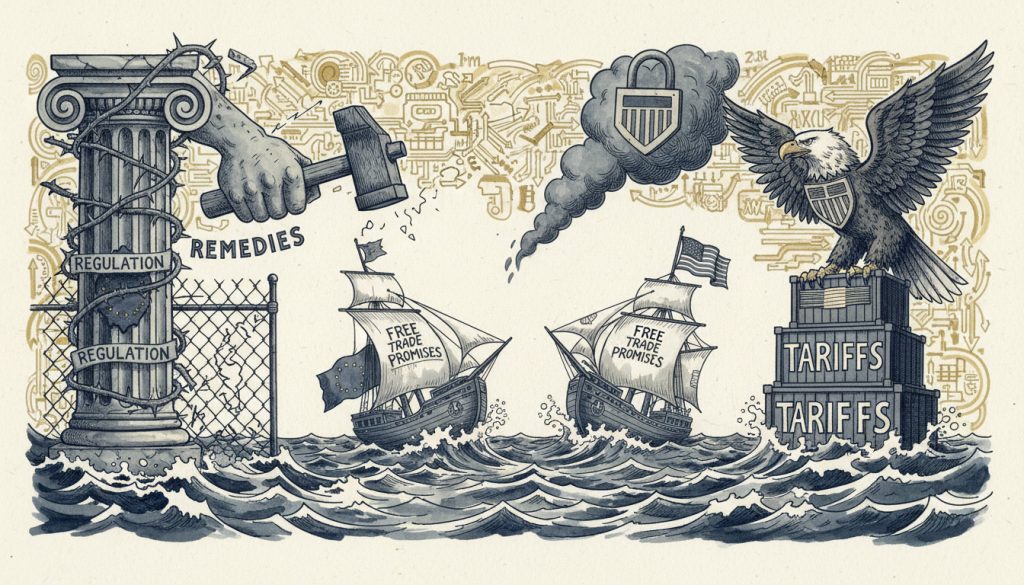
Politicians in Brussels and Washington long profess fealty to open markets and the efficiencies of comparative advantage. Yet beneath the rhetoric of free trade lies a dense web of duties, remedies and regulatory walls that function as selective protectionism. The European Union and the United States both balance growth and competitiveness against political pressures to shield jobs, strategic supply chains and sensitive constituencies. The result is less a bipolar contest of free trade versus autarky than a convergence around finely targeted tools — agricultural tariffs, sectoral duties, anti‑dumping and safeguard mechanisms, and a growing reliance on regulatory standards — that distort the simple narrative that “Europe opposes tariffs” while “America embraces them.”
Agriculture exposes the clearest divergence between rhetorical preference and practical shielding. Across the EU, a patchwork of tariffs, tariff‑rate quotas and domestic support preserves farming incomes and rural political coalitions. Average EU applied MFN tariffs are concentrated in agricultural lines: cereals, dairy, sugar and a range of processed foods carry significantly higher duties than many industrial goods. Brussels’ Common Agricultural Policy and tariff instruments are designed not merely to raise revenue but to manage market access — protecting EU producers from volatility and low‑cost competitors. By contrast, the United States applies comparatively lower statutory tariffs on many bulk agricultural commodities, yet Washington’s protection is no less potent: direct farm subsidies, insurance programs and occasional tariff measures (plus sanitary and phytosanitary standards) provide a different, often more opaque, form of support. In short, Europe’s tariff book is thicker for foodstuffs, while American support works through budgetary transfers and regulatory levers — both politically consequential.
When it comes to manufacturing, the headline numbers mask stark sectoral variation. Passenger cars remain emblematic. The EU’s common external tariff on cars sits at roughly 10 percent, a clear and blunt instrument of protection that applies to non‑EU imports. The United States, by contrast, maintains a statutory duty on passenger vehicles at 2.5 percent — low by historical standards — but U.S. trade policy has not relied on low MFN rates alone. Washington’s playbook over the last decade has featured heavy, targeted measures: Section 232 national‑security tariffs on steel (25 percent) and aluminum (10 percent) in 2018; Section 301 tariffs on certain Chinese goods; and a resurgent use of anti‑dumping and countervailing duties. The practical effect is that while EU MFN duties can be higher for some sectors (notably autos), the United States frequently raises effective protection abruptly and selectively, tethered to geopolitical priorities and domestic politics.
Steel and other metals illustrate the convergence and the difference. The EU applies a mix of MFN duties, temporary safeguard measures and a robust set of anti‑dumping and anti‑subsidy instruments. Brussels has used duties and quotas periodically to protect its steel industry, and it maintains a Trade Defence Instruments regime that enables tariffs vis‑à‑vis specific countries or dumped imports. The U.S. approach in the late 2010s made headlines by leveraging national‑security tariffs that applied bluntly across many origins — though in practice exemptions, quotas and bilateral negotiations often diluted universality. Both jurisdictions therefore use similar tools; they diverge in legal framing (EU law emphasizes trade remedies; U.S. measures leaned on national‑security and unilateral political decisions) and in the frequency and discretion of their deployment.
Electronics and semiconductors underscore how low headline tariffs coexist with high effective barriers. On paper, most consumer electronics and semiconductor parts enter both the EU and the U.S. at zero or negligible MFN tariffs. But regulatory divergence — standards, testing, data rules and industrial policy — creates frictions that amount to protection. The EU’s extensive regulatory regimes for chemicals, product safety and environmental standards (REACH, new Ecodesign rules) can slow market access and raise costs for outsiders; they are not tariffs, but they serve similarly selective ends. Washington has increasingly paired export controls, investment screening and targeted import duties with subsidy packages for domestic chip capacity, producing an industrial policy that erects non‑tariff walls while leaving statutory tariffs low for many lines.
Textiles and apparel reveal another pattern: both economies use differentiated tariffs and preferences. Apparel duties in the EU tend to be moderate across many categories, with tariff‑rate quotas and rules of origin shaping effective protection. U.S. duties on garments and textiles vary by fabric and construction and can be higher for specific products; yet both sides substantially reduce or zero tariffs under free‑trade agreements and preferential schemes. The political economy here is granular — domestic producers, retailers and global supply chains lobby for exemptions, quotas and rules that tilt access in practice more than headline rates suggest.
Two broader trends matter when evaluating the tariff landscape. First, anti‑dumping and countervailing duties have become central instruments in both jurisdictions. The EU’s Trade Defence Instruments and the U.S. Department of Commerce’s AD/CVD machinery are used regularly to impose duties that exceed MFN levels for specific exporters or product lines. This “targeted tariffing” allows policymakers to claim general openness while defending strategic industries case‑by‑case. Second, non‑tariff measures — standards, technical barriers, procurement rules, investment screening and subsidy regimes — are assuming the role once played almost exclusively by tariffs. The EU’s preference for high regulatory standards and Washington’s growing use of industrial subsidies both erect durable barriers to foreign competitors.
Rhetoric and politics drive these choices. European leaders may rhetorically denounce tariffs and favor open markets; yet domestic politics — farmers’ unions, regional employers, industrial federations — press Brussels for protection, and the EU’s institutional design channels these pressures into common external tariffs and trade defence actions. In the U.S., defenders of free trade face different pressures: concern about manufacturing decline, political salience of steel and auto communities, and a foreign‑policy impulse to counter China. Consequently, American policy has become more transactionally protectionist — imposing steep, temporary tariffs or controls targeted at particular partners or strategic sectors while maintaining low MFN rates elsewhere.
The policy consequences matter. High agricultural protection in the EU keeps food prices higher than they might otherwise be and sustains rural employment — but it also curtails market opportunities for exporters and fuels trade tensions. Targeted steel tariffs and anti‑dumping duties preserve capacity and jobs in politically sensitive sectors but invite retaliation and disrupt global supply chains. Non‑tariff barriers shaped by regulatory precaution can protect health and the environment, yet also substitute for tariffs to shield domestic firms. For global supply chains that weave across continents, these layered protections add complexity: producers face origin‑specific duties, steps to navigate rules of origin, and regulatory compliance costs, which together can be more trade‑restrictive than headline tariffs suggest.
Ultimately, neither Brussels nor Washington adheres to a purist free‑trade creed. The EU’s higher protection of agriculture and more extensive use of regulatory standards sits alongside a general openness for industrial goods, while the U.S. combines low statutory MFN tariffs in many sectors with episodic, forceful interventions when political or security concerns rise. The political theater of “no tariffs” is thus frequently a rhetorical posture; the policy reality is a nuanced, instrument‑rich approach that reconciles liberal trade principles with the perennial imperative to defend domestic economic and geopolitical interests. Understanding modern protectionism requires moving beyond simple tariff tallies to a mosaic view — one that accounts for duties, remedies, subsidies and rules that together shape the true contour of market access between the EU, the United States and the world.
For more context read about Section 232 of the Trade Expansion Act of 1962.
For more context read about Section 301 of the Trade Act of 1974.